Leave Your Message

How to Choose Bonded Neodymium Magnets?

Choosing Bonded Neodymium Magnets requires more than comparing attractive force on a product page. The right magnet must match the assembly, operating temperature, available space, and expected service life. A compact sensor housing may need a thin, accurately molded ring. A motor component may demand stronger retention, tighter tolerances, and better heat resistance. Small details matter.

In practical design work, engineers usually begin with the application rather than the magnet grade. They check the required holding force, magnetic direction, surface coating, and bonding method. They also review demagnetization risks under heat, vibration, and repeated loading. A datasheet can show useful values, but it cannot replace testing inside the finished product. Real assemblies often behave differently. This is where early prototypes help.

Supplier reliability deserves equal attention. Look for clear material specifications, dimensional tolerances, inspection records, and traceable test results. Ask whether the supplier can provide samples from the intended production process. Check coating quality with the actual environment in mind, especially where moisture or chemicals may occur. Do not rely on strength claims alone. Weak assumptions become expensive failures. A carefully selected Bonded Neodymium Magnets solution should balance performance, manufacturability, cost, and long-term stability. The best choice may not be the strongest option. It may be the magnet that remains consistent after assembly, temperature cycling, and years of ordinary use. Mistakes can happen. Thoughtful verification reduces them.
How to Choose Bonded Neodymium Magnets?

Define the Working Principles of Bonded Neodymium Magnets

Bonded neodymium magnets combine neodymium-iron-boron powder with a polymer binder. The binder holds each magnetic particle in a stable shape. During manufacturing, pressure, heat, and sometimes an external magnetic field form the final component. The working principle is simple, but the details matter.

After magnetization, tiny magnetic domains inside the particles create a unified magnetic field. In an isotropic material, particles point in many directions, so magnetic strength is more evenly distributed. Anisotropic material uses field alignment during forming, usually producing stronger performance in one preferred direction. The finished magnet then works through attraction, repulsion, and the design of its magnetic circuit. A steel pole piece can guide flux toward a target surface. An air gap can reduce holding force sharply.

Choosing a bonded neodymium magnet requires more than checking its listed surface strength. Measure the required pull force at the real working distance. Consider temperature, vibration, moisture, and repeated cycling. The polymer binder can improve dimensional accuracy and corrosion resistance, but it usually lowers magnetic energy compared with a fully sintered magnet. That trade-off is easy to overlook. It is also worth testing early samples under actual load, because calculated values may not match assembly conditions. A small change in wall thickness or magnet position can alter the field noticeably. Temperature may weaken performance, and recovery is not always complete after cooling. Real testing remains necessary.

Identify Required Magnetic, Mechanical, and Environmental Properties

Choosing bonded neodymium magnets starts with the real working conditions, not a catalog rating. Define the required holding force, magnetic direction, operating gap, and available space. A magnet that performs well against bare steel may weaken behind paint, plastic, or an air gap. Measure the gap carefully. Small changes can create large force losses.

Mechanical properties deserve equal attention. Check tensile force, shear load, torque, impact, and vibration. For rotating parts, confirm balance and dimensional tolerance. Bonded magnets are often easier to shape than sintered magnets, but they may not tolerate excessive clamping pressure. Select a compatible adhesive and allow for its curing shrinkage. I have seen assemblies fail because the magnet was strong, while the adhesive joint was ignored.

Environmental testing should match the application. Record the expected temperature range, humidity, salt exposure, chemicals, and cleaning methods. Many bonded materials lose performance when heated continuously, even below their short-term limit. Ask for test conditions, not only headline values. Verify coating adhesion and corrosion resistance with representative samples. A controlled pull test at room temperature is useful, but incomplete. Repeat it after heat, moisture, and vibration exposure. Perfect specifications are rare. Leave safety margin, and question any result that cannot be reproduced.

How to Choose Bonded Neodymium Magnets? - Identify Required Magnetic, Mechanical, and Environmental Properties

Property Category Property Typical Values or Selection Range Why It Matters Selection and Verification Guidance
Magnetic Properties Residual Induction (Br) Approximately 0.45–0.75 T (4.5–7.5 kG), depending on powder loading, orientation, and binder system. Indicates the magnetic flux remaining after magnetization and strongly affects air-gap flux density. Choose a higher Br when space is limited. Confirm the value on the supplier’s hysteresis report at the specified temperature.
Coercive Field Strength (Hcb) Commonly about 350–900 kA/m, depending on material formulation and grade. Shows resistance to demagnetization under an opposing magnetic field. Select sufficient Hcb for the magnetic circuit, especially where reverse fields or armature reaction may occur.
Intrinsic Coercivity (Hcj) Typically about 600–1,800 kA/m. Measures resistance to irreversible demagnetization and is particularly important at elevated temperature. Use a higher Hcj grade for motors, sensors, and applications exposed to strong opposing fields or temperature cycling.
Maximum Energy Product ((BH)max) Approximately 35–100 kJ/m³ (about 4.5–12.5 MGOe). Represents the magnetic energy available per unit volume. Select a higher value when the magnet must be smaller or when a larger working air gap is required.
Temperature Coefficient Br: approximately −0.10 to −0.13%/°C; Hcj: commonly −0.5 to −0.7%/°C. Magnetic output generally decreases as temperature rises. Calculate magnetic performance at the actual minimum and maximum operating temperatures, not only at room temperature.
Magnetization Direction Axial, diametral, multipole, radial, or custom patterns are possible depending on the geometry and process. The pole arrangement determines how the magnet interacts with the surrounding magnetic circuit. Specify pole locations, polarity, field direction, and any required magnetic angle or multipole pattern on the drawing.
Mechanical Properties Material Density Usually approximately 5.5–6.2 g/cm³ for polymer-bonded neodymium materials. Affects component weight, balance, inertia, and the amount of magnetic powder in the compound. Use density together with Br and dimensional data when calculating mass and magnetic performance per unit weight.
Tensile Strength Often approximately 20–50 MPa, depending on binder, powder concentration, and molding process. Determines resistance to pulling, stretching, and handling-related damage. Do not use the upper end of the range without test data. Apply an appropriate safety factor for assembled or rotating parts.
Compressive Strength Frequently about 50–150 MPa, but strongly formulation-dependent. Important when the magnet is clamped, press-fitted, or exposed to repeated contact loads. Check the actual test method and temperature. Avoid concentrated loads, sharp edges, and excessive interference fits.
Dimensional Tolerance Molded parts commonly require approximately ±0.05–0.20 mm, depending on size, geometry, and tooling. Controls fit, air gap, alignment, and repeatability in the final assembly. Define critical dimensions separately from noncritical dimensions and confirm tolerance capability with prototype parts.
Impact and Vibration Resistance Generally better than brittle sintered magnets because the polymer binder provides toughness; actual performance varies by design. Determines whether the magnet can survive drops, shock, vibration, and repeated cycling. Validate the complete assembly using the expected vibration spectrum, shock level, cycle count, and mounting method.
Environmental Properties Continuous Operating Temperature Many grades are designed for approximately 80–120°C; specialized formulations may reach about 150°C. Temperature can reduce magnetic output and may soften or degrade the polymer binder. Base the specification on the highest sustained temperature, short-term peaks, and the required magnetic life after exposure.
Humidity and Water Exposure Resistance depends on binder type, void content, molding quality, and any protective coating. Moisture can promote corrosion of exposed magnetic particles and affect mechanical or dimensional stability. Specify the required humidity, immersion, or water-spray test and evaluate finished parts rather than loose powder or unprocessed material.
Corrosion Resistance Usually better than unprotected sintered neodymium magnets when the magnetic powder is fully encapsulated, but not inherently corrosion-proof. Corrosion may reduce magnetic performance, damage the surface, or contaminate nearby components. For salt, condensation, or outdoor exposure, verify coating, sealing, edge coverage, and corrosion-test results.
Chemical Compatibility Must be evaluated against oils, fuels, solvents, cleaners, adhesives, and plasticizers used in the application. Chemicals can swell, soften, crack, or permeate the binder and protective coating. Test the finished magnet in the actual chemical environment at the highest expected temperature and exposure duration.
Thermal Cycling Performance depends on the temperature span, heating and cooling rate, binder expansion, and assembly constraints. Repeated expansion and contraction can cause cracking, delamination, dimensional change, or irreversible magnetic loss. Specify the temperature range and number of cycles; test the magnet after cycling for flux, dimensions, and visual damage.
Flammability and Regulatory Requirements The rating depends mainly on the polymer binder and any additives; requirements vary by end-use sector. Electrical, automotive, appliance, and enclosed-equipment applications may require specific flammability or material declarations. State the applicable flammability, restricted-substance, and recycling requirements before selecting the binder system.
Recommended Final Check Specify the required magnetic field or flux at the working temperature, magnetization direction, critical dimensions, load conditions, temperature range, humidity or chemical exposure, expected service life, and validation tests. Typical values are guidelines only; the final design should be confirmed with a material datasheet, magnetic-circuit calculation, and application-level testing.

Note: Actual properties vary with neodymium powder loading, particle orientation, binder chemistry, molding process, geometry, and test method.

Compare Magnet Grades, Shapes, Coatings, and Manufacturing Methods

How to Choose Bonded Neodymium Magnets?

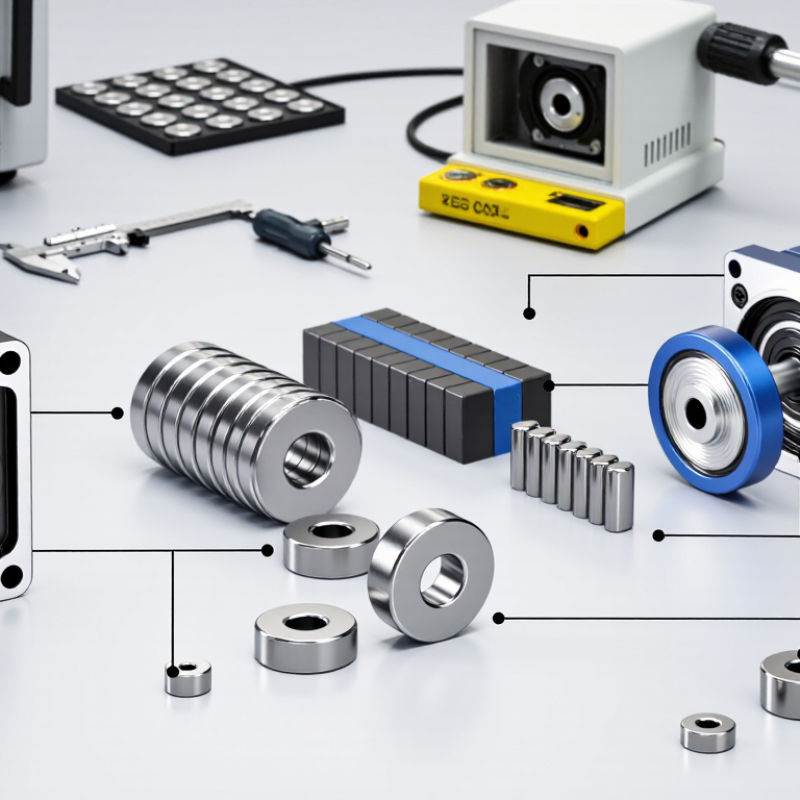
Bonded neodymium magnets combine magnetic powder with a polymer binder. Their grade indicates magnetic strength, temperature resistance, and energy density. Higher grades create stronger fields in smaller spaces. However, they may cost more and need tighter process control. Check the working temperature before comparing strength. A magnet inside a warm motor needs different protection from one used in a cool sensor. Shapes also affect performance. Rings suit rotating assemblies, while discs fit compact switches. Blocks provide useful directional force. Curved segments can match a motor’s internal surface. Measure the available space carefully. A strong magnet is useless if it cannot fit.

Manufacturing methods change both shape and consistency. Compression molding can produce dense parts with strong magnetic performance. Injection molding supports complex shapes and integrated holes. It may leave slightly lower magnetic strength because of its higher binder content. This trade-off is easy to overlook. Coatings protect the magnet from moisture and handling damage. Nickel-based coatings suit many indoor applications, while epoxy coatings offer better insulation and surface coverage. Select coating thickness according to clearance and wear. Thin coatings can fail near sharp edges. During inspection, check dimensions, coating adhesion, and magnetization direction. A simple pull test is not enough. Use a gauss meter when field accuracy matters. Datasheets help, but real assembly tests reveal problems. My own selection process would still include one imperfect prototype before volume production.

Match Magnet Specifications to the Intended Application

When choosing bonded neodymium magnets, match every specification to the working environment. Start with required magnetic force, available space, and the air gap between magnet and target. A larger magnet is not always better. It may add weight, cost, or unwanted magnetic interference.

Review remanence, coercivity, and maximum operating temperature on the technical datasheet. Bonded magnets usually provide lower magnetic strength than sintered types, but they offer excellent dimensional consistency and flexible shapes. That difference matters in sensors, small motors, encoders, and compact actuators. For rotating parts, check balance, radial strength, and resistance to repeated vibration. For holding applications, test pull force under the real surface condition, not on clean steel alone.

Heat matters. Ask whether nearby coils, friction, or sunlight can raise the magnet temperature. Select a suitable coating when moisture, chemicals, or salt exposure is expected. Small gaps reduce performance quickly. Prototype testing is essential. One lesson from application reviews is that calculated force can exceed practical force when surfaces are rough or misaligned. I once focused too heavily on peak strength and overlooked assembly tolerances. That choice created uneven movement and extra noise. Recheck the magnet after curing, pressing, or overmolding, because the binder and surrounding material can affect final dimensions. Use measured data from the finished assembly before approving production.

Verify Quality, Safety Standards, and Supplier Reliability

How to Choose Bonded Neodymium Magnets?

Choosing bonded neodymium magnets requires more than checking magnetic strength. Verify the grade, dimensions, coating, and operating temperature for your application. Ask for test data from the actual production lot, not only a general catalog sheet. Useful records include pull-force results, dimensional inspection, coating thickness, and demagnetization performance.

Safety matters during installation and use. Strong magnets can pinch fingers, damage nearby sensors, or interfere with medical devices. Check whether the magnet meets relevant RoHS, REACH, and quality-management requirements for your market. These documents support responsible sourcing, but they do not replace application-specific risk assessments. I have seen specifications look complete while temperature limits were unclear. That small gap can cause trouble later.

Tips: Request samples before placing a large order. Test them under real temperature, vibration, and humidity conditions. Confirm lot traceability and packaging protection. A reliable supplier should explain tolerances clearly and provide consistent inspection reports. Ask how nonconforming parts are controlled. Slow answers are warning signs. However, communication alone is not proof of quality; independent testing may still be necessary. Review production capacity, delivery history, and change-notification procedures. A supplier who reports material or process changes can help prevent unexpected performance loss. Avoid unusually low prices when testing, coating, or traceability appears limited. Reliability is built through evidence, not promises.

How to Choose Bonded Neodymium Magnets?

Compare the representative maximum energy product ranges of common bonded NdFeB manufacturing processes. Higher BHmax generally indicates greater magnetic energy density, but the correct choice must also consider shape, temperature, coating, tolerances, and application requirements.

Quality and supplier checks: Request a material datasheet, batch-specific certificate of analysis, magnetic test results, dimensional inspection records, and full lot traceability. Confirm that the supplier can provide applicable RoHS Directive 2011/65/EU with amendment (EU) 2015/863 and REACH Regulation (EC) No 1907/2006 declarations. ISO 9001 certification can support process consistency, but it should not replace product-specific test evidence.