What Are the Magnetic Properties of NiO?
Nio Magnetic Properties begin with an important distinction: nickel oxide (NiO) is not a conventional ferromagnet. At room temperature, its nickel moments mostly cancel, leaving little net magnetization. Yet that does not mean the spins are inactive. NiO is a classic antiferromagnet, and its magnetic order persists below a Néel temperature of about 523 K. That is roughly 250°C.
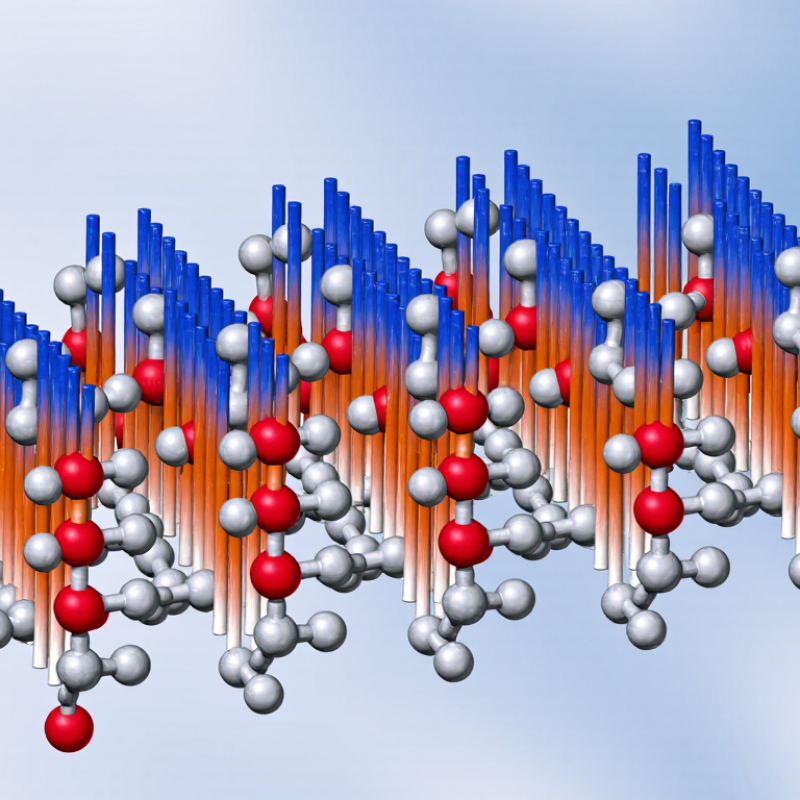
The crystal structure helps explain this behavior. NiO has the rock-salt structure, with Ni²⁺ and O²⁻ ions arranged in alternating lattice positions. Magnetic moments align in ferromagnetic sheets, then reverse between neighboring {111} planes. This pattern is called type-II antiferromagnetic order. In a widely cited neutron-diffraction report, W. L. Roth examined NiO’s magnetic structure alongside those of other transition-metal oxides (Physical Review, 1958, volume 110, page 1333). Such measurements provide a stronger basis than a simple magnetization reading, which can hide opposing spins.
The measured nickel moment is commonly reported near 1.9 Bohr magnetons, though values can vary with temperature, defects, and measurement method. That detail matters. Real samples are rarely perfect crystals. Oxygen vacancies, grain boundaries, and thin-film strain can alter magnetic response, so a single number does not describe every NiO specimen. The exchange interaction between nickel ions, mediated through oxygen, also contributes to the ordered state. This makes NiO useful for studying oxide magnetism and magnetic interfaces. Its behavior is well established, but interpreting a particular sample still requires care.
Chemical and Crystal Structure of Nickel Oxide
Nickel oxide, or NiO, is a simple-looking compound with a precise chemical identity. PubChem reports its molecular weight as 74.69 g/mol. In its common crystalline form, NiO adopts the rock-salt structure, also known as the sodium chloride structure. The Inorganic Crystal Structure Database records a cubic unit cell with a lattice parameter close to 4.17 angstroms. Small, repeating blocks.
Within each block, nickel and oxygen ions alternate across two interpenetrating face-centered cubic sublattices. Each nickel ion is surrounded by six oxygen ions, and each oxygen ion has six nickel neighbors. That octahedral arrangement helps explain NiO’s stable, compact crystal framework. Yet real samples are not always perfectly stoichiometric. Nickel vacancies can form, shifting the nickel-to-oxygen ratio and influencing electrical behavior. It is a useful reminder: a textbook crystal cell is tidy; a powder grain may be less so. NiO is also antiferromagnetic below a Néel temperature near 523 K, as reported in established magnetic-property compilations. This magnetic order arises within the same nickel–oxygen lattice, linking the compound’s structure to its behavior.
Antiferromagnetic Ordering in NiO
NiO is best understood as an antiferromagnet, not a simple magnetic solid. Below its Néel temperature, roughly 523 K (250 °C), neighboring magnetic planes order in opposite directions. Within each plane, Ni²⁺ moments align parallel; adjacent {111} planes point oppositely. Neutron-diffraction studies by Shull, Strauser, and Wollan (Physical Review, 1951) and Roth (Physical Review, 1958) established this type-II magnetic structure. The opposing moments largely cancel, so bulk NiO can show little net magnetization despite strong internal order.
The ordering comes from exchange interactions between nickel ions through oxygen, rather than from isolated ions acting alone. Below the transition, NiO also develops a small rhombohedral distortion, linking its magnetic and crystal structures. The textbook picture is useful, but real samples can be less tidy: defects, strain, and grain boundaries may affect measured magnetic behavior. That is worth remembering when comparing data.
Tips: For a practical check, compare measurements above and below 523 K, and note the sample’s form and thermal history. Thin films and powders may not behave exactly like a well-ordered crystal. Neutron diffraction reveals the alternating planes directly; a basic magnetization reading may not.
What Are the Magnetic Properties of NiO? — Antiferromagnetic Ordering in NiO
Nickel oxide (NiO) is antiferromagnetically ordered at room temperature. Its Néel temperature is approximately 523 K; above this transition, long-range antiferromagnetic order is lost.
The Néel Temperature and Magnetic Phase Changes
NiO’s magnetic behavior changes sharply near its Néel temperature, about 523 K (250°C) in bulk material. Below this point, it is an antiferromagnet: neighboring nickel moments largely oppose one another, so their magnetic effects mostly cancel. In its crystal structure, spins align within {111} planes and reverse direction between adjacent planes. The order is real, but not visually obvious. A sample may show little net magnetization despite strong internal alignment.
Tips: Compare measurements above and below 523 K, and note the sample’s form, defects, and strain. Thin films or fine particles may not match bulk values exactly.
As NiO warms through the transition, long-range antiferromagnetic order fades. Above the Néel point, it becomes paramagnetic, while local magnetic moments can still persist; thermal motion disrupts their coordinated pattern. This is not a switch that makes every specimen behave identically. The measured transition can broaden or shift with composition, grain size, and stress, so a single textbook temperature needs context. I would also avoid treating a weak magnetic reading as proof that NiO lacks magnetic order. Cancellation can hide that order from a simple bulk measurement.
Magnetic Moments and Spin Arrangement in NiO
In nickel oxide, nickel ions carry the main magnetic moments. NiO has a rocksalt crystal structure, with each nickel ion surrounded by six oxygen ions. This local environment shapes the nickel electrons’ energy levels. The Ni²⁺ ion has a 3d⁸ electron configuration and, in a simple picture, a spin of S = 1. Its spin-only moment is about two Bohr magnetons.
The spins do not point randomly. Below NiO’s Néel temperature, around 523 K, they align parallel within certain (111) planes. Neighboring planes point in the opposite direction. This pattern is called type-II antiferromagnetic order. The opposing moments largely cancel, so the crystal has little net magnetization, even though its spins are ordered. A neat arrangement.
The simple picture leaves details out. Nickel–oxygen bonding gives the electrons some shared character, while spin-orbit interactions and a slight distortion of the crystal affect preferred spin directions. As a result, measured magnetic moments can differ from the idealized value, depending on how they are measured and modeled. I find it useful to treat the “spin arrangement” as a clear map, not a complete account of every local interaction. The real material is less tidy.
What Are the Magnetic Properties of NiO? — Magnetic Moments and Spin Arrangement in NiO
| Property |
Value or description |
Context |
| Magnetic order |
Antiferromagnetic, specifically Type-II antiferromagnetic order |
Neighboring ferromagnetic planes have oppositely directed spins. |
| Néel temperature |
Approximately 523 K (about 250 °C) |
Below this temperature, bulk NiO is antiferromagnetically ordered; above it, long-range magnetic order is lost. |
| Magnetic ion |
Ni²⁺, with a 3d⁸ electronic configuration |
The Ni²⁺ ion has spin quantum number S = 1 in the usual description of NiO’s magnetic moments. |
| Spin-only moment |
Approximately 2.0 μB per Ni²⁺ ion |
This is the spin-only value for S = 1 with g ≈ 2; it is a theoretical reference, not the measured ordered moment. |
| Ordered moment |
Typically reported at roughly 1.7–1.9 μB per Ni |
Neutron-diffraction measurements commonly find a value below the spin-only estimate, reflecting the material’s electronic structure and covalent interactions. |
| Paramagnetic effective moment |
Approximately 2.83 μB per Ni²⁺ ion in the spin-only model |
Calculated as g√[S(S + 1)] μB for S = 1 and g ≈ 2. This differs from the ordered moment. |
| Spin arrangement |
Spins are parallel within {111} planes and alternate direction between successive planes |
This alternating stack of ferromagnetic planes produces the Type-II antiferromagnetic structure. |
| Spin direction |
Within a {111} plane; commonly described along a <11̅2>-type direction |
Equivalent magnetic domains can have different orientations because of the crystal’s symmetry. |
| Magnetic propagation vector |
(½, ½, ½) in cubic reciprocal-lattice units |
This describes the periodicity of the antiferromagnetic order relative to the cubic rocksalt structure. |
| Crystal structure |
Rocksalt (cubic) structure in the paramagnetic phase |
Magnetic ordering is accompanied by a small rhombohedral distortion below the Néel temperature. |
| Magnetic state at room temperature |
Antiferromagnetic |
Room temperature is below the bulk Néel temperature of approximately 523 K. |
Note: μB denotes the Bohr magneton. Reported ordered moments can vary somewhat with measurement method, sample condition, and the model used to interpret the data.
Effects of Defects, Strain, and External Fields on Its Magnetism
What Are the Magnetic Properties of NiO?
Nickel oxide (NiO) is an antiferromagnet: neighboring nickel spins point in opposite directions. Bulk NiO orders magnetically near 523 K, though composition and sample structure can shift measured behavior. Its opposing spins largely cancel, so a hand magnet will not reveal the full story. In a thin film, even small structural changes matter.
Defects can disturb this balance. Nickel vacancies and excess oxygen may alter local nickel valence and exchange between nearby spins. Grain boundaries can also create uncompensated moments, producing a weak magnetic signal that differs from ideal NiO. Strain changes nickel–oxygen bond lengths and angles, affecting exchange strength and magnetic anisotropy. Stretching a film along one direction may therefore favor certain spin orientations. External fields usually produce a modest response, but can cant spins or trigger transitions depending on field direction and sample conditions. Results are not always tidy; defects and strain often occur together, making their separate effects difficult to identify.
Tips: Compare samples with measured defect levels and strain, not just nominal compositions. Check temperature, field direction, and film thickness when interpreting magnetic data. A clean explanation can still miss local variation. That is worth keeping in mind.

 High Quality
 High Performance
 Technology Support