Professional NdFeB Magnets Manufacturer and Sales Center
High Quality
High Performance
Technology Support
Sintered Neodymium Magnets are compact powerhouses found inside electric motors, speakers, sensors, and industrial actuators. Their strength comes from a carefully controlled Nd-Fe-B alloy. Manufacturers press fine magnetic powder into a mold, then sinter it at high temperature. A magnetic field aligns the grains during processing. The result is a dense permanent magnet with exceptional magnetic energy.
The scale is significant. The International Energy Agency’s Global Critical Minerals Outlook 2024 reported that China supplied about 60% of mined magnet rare earths and 91% of refined output in 2023. The U.S. Geological Survey’s Mineral Commodity Summaries 2025 also identified China as the leading producer of rare-earth materials. These figures explain why supply security, recycling, and manufacturing expertise matter. They also show a weakness: production statistics do not always distinguish magnet-grade material from other rare-earth applications.
Dr. Masato Sagawa, a pioneer of neodymium-iron-boron magnets, described the discovery as “a result of serendipity.” His remark captures an important lesson. Breakthroughs may begin unexpectedly, but reliable magnets require disciplined control of composition, grain size, orientation, and surface protection. Tiny structural differences can change coercivity, heat resistance, and failure risk. That is where simple explanations become incomplete. This article examines what Sintered Neodymium Magnets are, how their microstructure creates magnetic force, and why performance depends on more than strength alone.
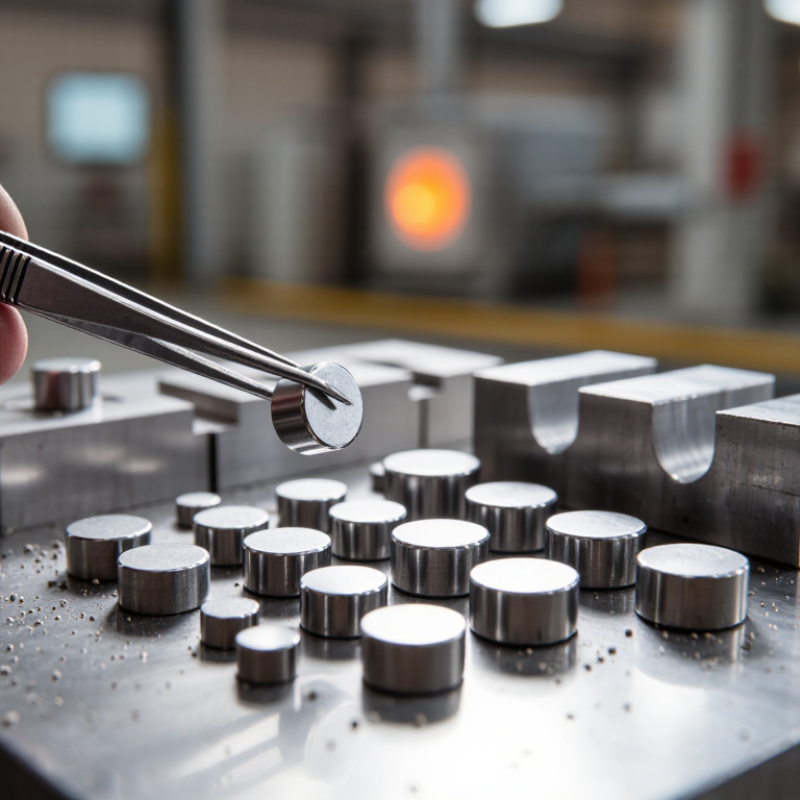
Sintered neodymium magnets are permanent magnets made mainly from neodymium, iron, and boron. They belong to the rare-earth magnet family. Their dense, crystalline structure creates a strong magnetic field in a compact shape. Manufacturers begin with a carefully prepared alloy. The alloy becomes fine powder, then pressure forms it inside a mold. The process sounds simple. It is not. Particle size, alignment, and oxygen control can change the final performance.
During pressing, an external magnetic field points many powder particles in one direction. The compact is then heated below its melting point. This step, called sintering, bonds the particles and increases density. After cooling, the block is cut, ground, and magnetized. A thin protective coating often helps reduce corrosion. Bare material can rust, especially in humid air. That weakness is easy to overlook.
These magnets work because aligned atomic magnetic moments reinforce one another. Their high magnetic energy supports small motors, sensors, speakers, closures, and lifting mechanisms. Shape and grade affect pull force, temperature resistance, and stability. A magnet’s published strength is not its full story. Air gaps, steel thickness, surface damage, and heat also matter. In practical testing, I would measure the actual assembly rather than trust a catalog value alone. Sintered magnets are powerful, but brittle. They can chip from sharp impacts or lose performance after excessive heat. Design choices deserve testing.
Sintered neodymium magnets are made mainly from a hard magnetic compound called neodymium-iron-boron, or Nd2Fe14B. Small amounts of dysprosium, terbium, cobalt, or other elements may adjust heat resistance and coercivity. The raw metals are melted, rapidly cooled, crushed, and milled into a fine powder. This powder is reactive, so controlled processing is essential.
Inside the magnet, countless crystal grains form a compact structure. Each grain contains magnetic moments that prefer a specific direction. During pressing, a magnetic field can align many grains before the powder is compressed. The pressed body then enters a furnace, where heat bonds the particles without fully melting them. Grain boundaries act like narrow barriers. They help prevent unwanted magnetic reversal, although their chemistry strongly affects performance.
A polished cross-section may look uniform, but it is not perfectly simple. Grain size, pores, surface defects, and uneven alignment can vary from one region to another. That variation matters. In practical inspection, technicians measure dimensions, magnetic flux, coating coverage, and resistance to heat or corrosion. A thicker coating can improve protection, yet it may change tight mechanical tolerances. This is an easy detail to overlook. The magnet works because aligned grains cooperate, while the internal boundaries resist changes in magnetization.
| Dimension | Typical Data or Description | Why It Matters |
|---|---|---|
| Magnet Type | Sintered rare-earth permanent magnet | The material is compacted and heat-treated as a solid body rather than bonded with a polymer. |
| Principal Magnetic Phase | Tetragonal Nd2Fe14B | This hard-magnetic phase provides high magnetocrystalline anisotropy and strong resistance to demagnetization. |
| Nominal Elemental Composition | Approximately 26.7 wt% neodymium, 72.3 wt% iron, and 1.0 wt% boron for the ideal Nd2Fe14B formula | Commercial formulations may also contain small additions of elements such as dysprosium, terbium, cobalt, copper, aluminum, niobium, or zirconium to adjust temperature performance and microstructure. |
| Crystal Structure | Tetragonal crystal structure | The unequal magnetic behavior along different crystal directions creates a preferred magnetization axis. |
| Internal Grain Structure | Fine, closely packed Nd2Fe14B grains, typically about 3–10 µm in diameter | Small, well-aligned grains and controlled grain boundaries improve coercivity and reduce easy reversal of magnetization. |
| Grain-Boundary Phase | A thin neodymium-rich intergranular phase, often containing Nd–Fe and other minor alloying elements | It magnetically separates neighboring grains and helps prevent domain-wall motion and reverse-domain nucleation. |
| Manufacturing Route | Alloy melting → strip casting or rapid solidification → hydrogen processing and milling → magnetic-field alignment → pressing → vacuum sintering → aging → machining and coating | Each stage controls particle size, density, grain orientation, phase distribution, and final magnetic performance. |
| Particle Alignment During Pressing | Powder particles are oriented in an applied magnetic field before or during compaction | Alignment produces an anisotropic magnet with a strong preferred direction of magnetization. |
| Typical Density | Approximately 7.4–7.6 g/cm³ | High density indicates that the sintering process has removed most interconnected pores and produced a mechanically solid magnet. |
| Typical Remanence, Br | Approximately 1.0–1.45 T, depending on composition, alignment, and grade | Remanence represents the magnetic flux density retained after the external magnetizing field is removed. |
| Typical Intrinsic Coercivity, Hcj | Approximately 750–2,750 kA/m, depending on microstructure and alloy design | Higher intrinsic coercivity gives greater resistance to irreversible demagnetization, especially at elevated temperature or under opposing magnetic fields. |
| Typical Maximum Energy Product, (BH)max | Approximately 200–440 kJ/m³ | This value indicates how much magnetic energy can be stored per unit volume and helps explain the compact size of many neodymium-magnet devices. |
| Curie Temperature | Approximately 310–330°C for the Nd2Fe14B phase | Above the Curie temperature, long-range ferromagnetic order is lost and the material becomes paramagnetic. |
| Temperature Coefficient of Remanence | Typically about −0.10 to −0.12% per °C near room temperature | Magnetic output decreases as temperature rises, although much of the loss is reversible if the magnet remains below its irreversible operating limit. |
| Electrical Conductivity | Conductive metallic ceramic-like composite; electrical resistivity is typically around 1.0–1.6 μΩ·m | Conductivity can allow eddy-current heating in rapidly changing magnetic fields, so segmented designs or specialized constructions may be used. |
| Mechanical Behavior | Hard and brittle; relatively strong in compression but sensitive to impact, tensile stress, and chipping | Machining is normally performed before final magnetization, and protective handling is required during assembly. |
| Corrosion Sensitivity | Moderate to high, especially in humid, salty, or acidic environments | A surface coating or plating is commonly used because exposed neodymium-rich phases can oxidize and cause surface deterioration. |
| How Magnetization Works | A strong external magnetic field aligns magnetic moments within the oriented Nd2Fe14B grains | The aligned moments create a persistent magnetic field after the magnetizing field is removed. |
| Main Sources of Magnetic Strength | High saturation magnetization, strong crystal anisotropy, fine grains, and controlled grain boundaries | The combination provides high magnetic output in a small volume while maintaining useful resistance to demagnetization. |
| Common Applications | Electric motors, generators, magnetic separators, speakers, sensors, magnetic couplings, and compact actuators | High energy density enables smaller and lighter magnetic components than many conventional permanent-magnet materials. |
Sintered neodymium magnets begin with a carefully controlled alloy of neodymium, iron, and boron. According to the U.S. Geological Survey’s Mineral Commodity Summaries 2025, global rare-earth mine production reached about 390,000 metric tons in 2024. China contributed approximately 270,000 tons, although not all material enters magnet production. The figures show why raw-material quality and supply stability matter.
Manufacturing starts by melting the alloy and forming thin strips through strip casting. Hydrogen processing then breaks the strips into a fragile powder. Jet milling produces particles only a few micrometers wide. Very small particles. A magnetic field aligns them during pressing, giving the future magnet a preferred direction of magnetization. This step strongly affects its final performance.
The compact is sintered in a vacuum furnace, usually near 1,000–1,100°C. Controlled cooling and aging improve density, coercivity, and dimensional stability. Technicians then grind the block, inspect its geometry, and apply a protective coating against moisture and corrosion. Experience on production lines shows that tiny oxygen changes can reduce magnetic performance. The process is precise, but not flawless. IEA’s Global Critical Minerals Outlook 2024 identifies permanent magnets as a major source of future rare-earth demand, increasing pressure for efficient manufacturing and careful material use. Some manufacturers still rely heavily on trial adjustments, which deserves more attention.
Sintered neodymium magnets generate their magnetic field through carefully controlled internal alignment. Manufacturers press fine magnetic powder inside a strong external field. This field encourages countless microscopic grains to point in similar directions. Heat then bonds the compacted powder into a dense, rigid magnet.
After cooling, the magnet receives a powerful magnetizing pulse. This pulse aligns magnetic domains across the material. Their combined effect produces a strong external field, with north and south poles fixed in position. The magnet does not continuously consume energy. Its field comes from stable atomic magnetic moments, not from an internal battery.
The key property is coercivity. It measures how strongly the material resists demagnetization. A well-made sintered magnet can maintain its field against ordinary nearby magnetic forces. Its fine grain structure also supports this resistance. However, the field is not permanent in an absolute sense. Excessive heat, strong opposing fields, corrosion, or physical damage can weaken it.
Temperature matters greatly. Heat increases atomic movement and can reduce magnetic alignment. Protective coatings help prevent corrosion, but they do not repair cracked surfaces. In technical applications, engineers verify field strength with calibrated instruments rather than relying on attraction alone. That simple test can mislead. The material grade, shape, air gap, and temperature all influence the measured force. The basic explanation works, but real magnet behavior deserves careful measurement.
Sintered neodymium magnets are made from compacted alloy powder, usually containing neodymium, iron, and boron. Manufacturers press the powder in a magnetic field, then sinter it at high temperature. This creates a dense, strongly aligned structure. After machining and coating, the magnet can deliver high magnetic energy in a small volume. The U.S. Department of Energy’s 2023 Critical Materials Assessment identifies neodymium and praseodymium as important materials for high-performance permanent magnets.
This property supports compact motors, generators, sensors, loudspeakers, magnetic couplings, and medical equipment. The International Energy Agency’s Global Critical Minerals Outlook 2024 identifies magnet rare earths as a rapidly growing demand area, linked partly to electric vehicles and wind power. USGS Mineral Commodity Summaries 2025 reports approximately 390,000 metric tons of rare-earth oxide equivalent were mined globally in 2024, showing the scale of the wider supply system, not magnet production alone.
Handling requires discipline. These magnets can pinch skin, damage electronics, and shatter during impact. Heat is another weakness; excessive temperatures can permanently reduce magnetic performance. Corrosion may begin at scratches or exposed edges, so coatings should be inspected before use. Machining them casually is risky because dust can ignite. A practical mistake is treating high strength as unlimited durability. It is not. Design checks should consider temperature, coating damage, impact, demagnetizing fields, and safe separation procedures. Even experienced users sometimes underestimate sudden attraction.