How to Choose NdFeB Rare Earth Magnets in 2026?
Choosing Rare Earth Magnets Ndfeb in 2026 requires more than comparing prices or selecting the strongest grade. Engineers must connect magnetic performance with temperature, geometry, corrosion risk, and operating conditions. A magnet that performs well in a laboratory may lose efficiency inside a hot motor or poorly sealed sensor.
John M. D. Coey, a recognized authority in magnetism, explains, “Permanent magnets are materials that retain their magnetization in the absence of an applied magnetic field.” This principle remains practical. Buyers should examine remanence, coercivity, maximum energy product, and reversible temperature coefficients. Grades such as N35, N42, and N52 are not interchangeable. Higher strength can create assembly risks, cracking, or unnecessary cost.
The 2026 selection process should also assess coating quality, dimensional tolerance, magnetization direction, and supplier traceability. Ask for batch documentation, technical data sheets, and test conditions. A reliable supplier should explain whether the reported values represent typical or guaranteed performance. That detail matters.
Do not ignore the application environment. Salt spray, vibration, heat cycles, and nearby steel components can change the result. No checklist is perfect. Some designs still require prototype testing. A small trial assembly can reveal pull-force loss, alignment problems, or unexpected heating before full production begins. Price volatility in rare earth materials also deserves attention, but low cost should never replace verified quality. The best choice balances performance, durability, safety, availability, and total lifetime value. In 2026, careful magnet selection is less about chasing maximum power and more about avoiding expensive surprises.
NdFeB Magnets: Definition, Structure, and Key Properties
How to Choose NdFeB Rare Earth Magnets in 2026?
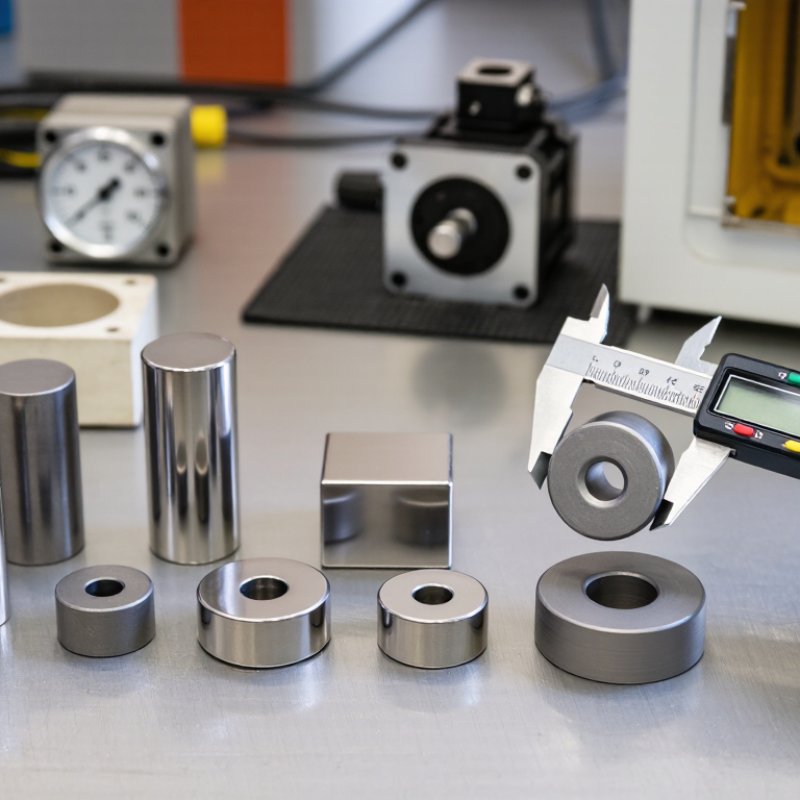
NdFeB magnets are permanent magnets based on the tetragonal Nd2Fe14B crystal structure. Their aligned grains create strong magnetic anisotropy. A small magnet can produce high force in motors, sensors, speakers, and compact actuators. According to the U.S. Geological Survey’s Mineral Commodity Summaries 2025, global rare-earth mine production reached about 390,000 metric tons in 2024. China accounted for approximately 270,000 tons. This supply concentration makes traceable material sourcing increasingly important.
Key properties decide whether a magnet works in practice. Remanence, Br, indicates retained magnetic strength. Coercivity, Hcj, shows resistance to demagnetization. Maximum energy product, BHmax, helps compare compact designs. Temperature matters too. Many standard grades lose performance near 80°C, while high-temperature grades require stronger coercivity and suitable processing. The International Energy Agency reported in 2024 that permanent magnets represent a major share of rare-earth demand growth through clean-energy technologies. Demand alone, however, does not guarantee dependable selection.
Check the working temperature, magnetic circuit, coating, tolerances, and mechanical stress. NdFeB is hard but brittle. It can chip around sharp edges. Nickel-based coatings resist ordinary handling, yet salt spray may require additional protection. A common mistake is choosing the highest BHmax grade. That shortcut is tempting, but incomplete. In real assemblies, heat, air gaps, surface damage, and aging can matter more than a catalog headline. Review measured data, not only nominal values. Geological reports also change yearly, so procurement assumptions deserve another check.
Match Magnet Specifications to Your Application Requirements
Choosing NdFeB rare earth magnets in 2026 starts with the application, not the catalog. Define the required holding force, working gap, movement, and available space. A magnet rated highly on paper may perform poorly across a wide air gap. Shape matters too. A disc suits compact axial loads, while a block can provide better positioning. Select the magnetic grade according to operating temperature and demagnetization risk. Higher performance is not always necessary.
Tips: Measure the real air gap. Include coatings. Check tolerances. Test assembled parts.
In practical design reviews, corrosion protection is often underestimated. Moisture, salt, and repeated handling can damage an unsuitable surface. Choose a coating that matches the environment, then verify its thickness and durability. Consider nearby steel components, because they can redirect magnetic flux. Also review installation forces. A strong magnet may pinch components or crack during assembly. I have seen projects specify maximum pull force but ignore side loading and impact. That mistake can change the result. Build a simple prototype and test it at the highest expected temperature. Record force, alignment, and surface condition. Supplier data is useful, but application testing remains more reliable. A perfect specification rarely exists. Recheck the design after real-world testing.
How to Choose NdFeB Rare Earth Magnets in 2026? - Match Magnet Specifications to Your Application Requirements
| Typical NdFeB Grade |
Typical Maximum Energy Product
(MGOe / kJ/m³) |
Typical Remanence, Br
(kG / T) |
Typical Intrinsic Coercivity, Hcj
(kOe / kA/m) |
Maximum Recommended Working Temperature |
Main Strength |
Suitable Application Conditions |
Common Application Examples |
| N35 |
33–36 / 263–287 |
11.7–12.2 / 1.17–1.22 |
≥10 / ≥796 |
Approximately 80°C |
Cost-effective general-purpose magnetic strength |
Low-temperature indoor environments with limited thermal exposure |
Small fixtures, sensors, magnetic closures, craft and educational products |
| N42 |
40–43 / 318–342 |
12.8–13.2 / 1.28–1.32 |
≥10.8 / ≥860 |
Approximately 80°C |
Balanced strength and material cost |
General industrial and commercial applications without significant heat |
Holding systems, compact actuators, magnetic couplings and brackets |
| N48 |
46–49 / 366–390 |
13.6–14.1 / 1.36–1.41 |
≥10.5 / ≥836 |
Approximately 80°C |
High magnetic output in a limited volume |
Space-constrained designs where operating temperature is controlled |
Miniature motors, compact magnetic sensors and high-force holders |
| N52 |
50–53 / 398–422 |
14.2–14.8 / 1.42–1.48 |
≥9.5 / ≥756 |
Approximately 60–80°C |
Very high remanence and maximum force per unit volume |
Use only when the magnet remains below the specified temperature limit |
Compact prototypes, high-force closures, lightweight magnetic assemblies |
| N35H |
33–36 / 263–287 |
11.7–12.2 / 1.17–1.22 |
≥17 / ≥1,353 |
Approximately 120°C |
Improved resistance to irreversible demagnetization |
Moderate-temperature environments requiring reliable magnetic stability |
Automotive sensors, small motors, industrial fixtures and pumps |
| N42H |
40–43 / 318–342 |
12.8–13.2 / 1.28–1.32 |
≥17 / ≥1,353 |
Approximately 120°C |
Higher magnetic strength with better thermal capability than standard grades |
Applications exposed to sustained temperatures near 100–120°C |
Motors, generators, magnetic couplings and industrial automation equipment |
| N38SH |
36–39 / 287–310 |
12.2–12.6 / 1.22–1.26 |
≥20 / ≥1,592 |
Approximately 150°C |
Strong thermal stability with high coercivity |
Repeated heating cycles, elevated-temperature motors and compact assemblies |
Automotive actuators, industrial motors and high-temperature sensors |
| N38UH |
36–39 / 287–310 |
12.2–12.6 / 1.22–1.26 |
≥25 / ≥1,989 |
Approximately 180°C |
Very high resistance to thermal demagnetization |
High-temperature operation where long-term magnetic stability is critical |
Traction motors, generators, industrial drives and high-temperature actuators |
| N35EH |
33–36 / 263–287 |
11.7–12.2 / 1.17–1.22 |
≥30 / ≥2,387 |
Approximately 200°C |
Extremely high intrinsic coercivity |
Severe thermal conditions and applications with strong opposing magnetic fields |
High-temperature motors, generators and specialized aerospace equipment |
| N30AH |
28–31 / 223–247 |
10.8–11.3 / 1.08–1.13 |
≥35 / ≥2,785 |
Approximately 220°C |
Exceptional resistance to irreversible demagnetization |
Extreme-temperature or high-demagnetizing-field environments |
Specialized high-temperature motors, generators and demanding industrial systems |
Selection note: Grade values are typical reference ranges rather than guaranteed product specifications. Final selection should also consider magnet dimensions, working point, air gap, magnetic circuit design, temperature coefficient, corrosion protection, mechanical shock, coating requirements and applicable safety standards. NdFeB magnets are generally brittle and require suitable handling and mechanical retention.
Evaluate Temperature Resistance, Coatings, and Operating Conditions
How to Choose NdFeB Rare Earth Magnets in 2026?
Temperature resistance should guide your NdFeB magnet selection. Standard grades may lose performance as temperatures rise. Check the magnet’s maximum operating temperature, not only its room-temperature strength. A motor near a 120°C housing needs a safer thermal margin. Irreversible demagnetization can begin when heat exceeds the selected grade’s limits. Measure real temperatures during startup, continuous operation, and sudden load changes. A short thermal test is more reliable than a catalog estimate. I have seen designs fail because engineers measured air temperature instead of the magnet surface.
Tips: Choose the coating after studying moisture, chemicals, and contact pressure. Nickel-based coatings suit many indoor assemblies. Epoxy coatings may help in humid environments, but scratches can expose the metal. Inspect edges and drilled areas carefully. Small defects matter.
Operating conditions also include vibration, impact, magnetic gaps, and nearby steel. A thin air gap can improve force, but poor alignment may create uneven stress. Salt, condensation, and cleaning fluids can accelerate corrosion. Ask for coating thickness, adhesion data, temperature testing, and batch inspection records. Keep tolerances realistic; overly tight specifications increase cost without always improving performance. A practical prototype should run under the worst credible conditions. It may reveal an overlooked weakness. Recheck the design after testing, because calculated holding force rarely matches a vibrating assembly perfectly.
Compare Quality, Safety, Cost, and Supplier Reliability Before Buying
In practical sourcing, NdFeB magnet quality starts with the application, not the advertised grade. Check magnetic strength, operating temperature, dimensions, coating, and tolerance together. A strong magnet can still fail when heat reduces its performance. Ask for batch test reports, surface inspection records, and measured pull-force data. Do not rely on a catalog number alone.
Safety deserves equal attention. Specify the magnet’s working distance, impact risk, and assembly method before ordering. Sharp edges, brittle coatings, and sudden attraction can damage parts or injure workers. Keep magnets away from sensitive electronic devices and clearly label storage containers. Small magnets are especially dangerous if swallowed. Stronger is not always better.
Cost comparisons should include coating quality, machining accuracy, packaging, testing, and replacement risk. A low unit price may hide high rejection rates. Request samples from the actual production process, then test them after coating and at the expected temperature. Supplier reliability shows through traceability, response speed, stable lead times, and honest disclosure of production limits. Ask who performs final inspection and how failed batches are handled. I once treated a clean sample as proof of consistency; that assumption was too optimistic. Independent verification can feel expensive, but one failed shipment may cost more. Leave room for that possibility.
Typical NdFeB grade trade-offs: higher grades generally provide greater maximum energy product, while temperature-rated grades offer improved thermal safety. The values shown are common industry ranges; actual cost and supplier reliability should be verified through quotations, test reports, coating specifications, batch traceability, and quality certifications.

 High Quality
 High Performance
 Technology Support